A 10 cm Earth puts the Moon about 3 m away
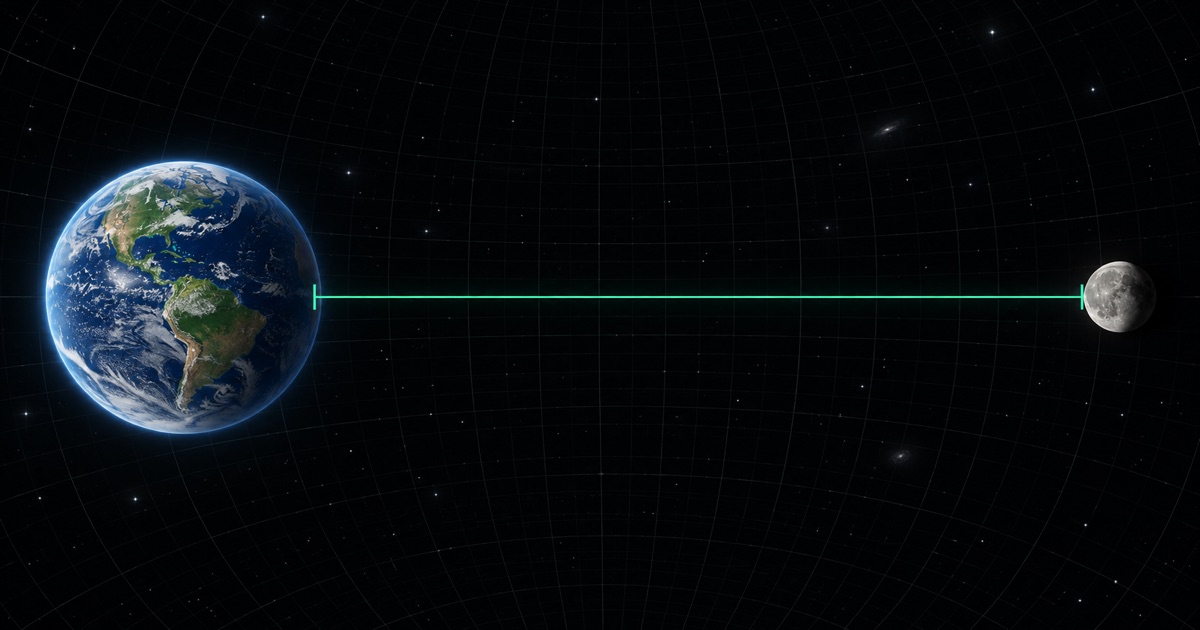
Imagine shrinking Earth to a ball you can hold. Shrink the Moon and the gap by exactly the same amount. The Moon is much farther away than a close-up drawing suggests.
Work it out, one step at a time
Find how many Earth widths span the distance
384,400 ÷ 12,742 ≈ 30.2
Both lengths are in kilometres, so dividing gives a ratio with no unit.
Use your model Earth’s width
30.2 × 10 cm ≈ 302 cm ≈ 3 m
Measure between the centres of the balls, not between their nearest surfaces.
Words made simple
- Average
- A representative distance; the Moon moves nearer and farther during its orbit.
- Scale model
- Every length is multiplied by the same factor.
Think about it: If the Earth ball grows to 20 cm, what happens to the gap?
It doubles to about 6 m. The Moon ball must also double in size. Changing only one length would break the scale.
Where the numbers come from: NASA Space Place · NASA JPL · NASA JPL. The illustration and worked model are made for this lesson; assumptions are stated above.
Build a scale modelChoose two references and change the model size.
Compare with another scale
Build a scale model of any two lengths
Choose from all 71 Macro and 54 Micro references, or enter your own length. Set B’s model length and see A change on the same fixed metre ruler. The bars represent the stated lengths, including their different measurement definitions.
- Length ratio A / B
- Model length B
- Calculated model length A
A · Earth–Moon distance
3.844e+8 m
Approximate mean centre-to-centre Earth–Moon separation.
Source claim checked
Distance varies over time; use an ephemeris for a date-specific separation.
Definition and evidence reviewOriginal sourceB · Sun radius
6.960e+8 m
Comparison derived from the nominal solar radius: 695,700 km → 696,000 km.
Calculated from a sourced value
The IAU nominal radius is an exact conversion constant, not the true instantaneous solar radius. This comparison rounds it first; the diameter doubles that rounded radius.
Definition and evidence reviewOriginal sourcemodel A = (A / B) × model B
This calculator uses the existing journey comparison inputs. Review-pending or conceptual entries remain illustrative inputs here; the public reviewed dataset keeps their numeric values withheld. Radius, height, diameter and experimental bound keep their individual definitions.
Experiment · distance, size and signal delay
Build an Earth–Moon model that keeps the real ratio
Change the centre separation first. Notice how little the Moon moves relative to the wide gap. Then choose an Earth-model diameter: this changes your tabletop model, while the real distance stays the same.
Earth model diameter: Highlighted model span:
- Centre separation
- Near-surface gap
- Separation / Earth diameter
- One-way light delay
- Ideal round-trip light delay
- Model centre separation
- Model Moon diameter
- Apparent angular size / mean
If Earth is 1 metre wide, where is the Moon?
About 30.168 metres from Earth’s centre, with a Moon model about 27.27 cm wide. These are calculated scale-model dimensions from a 384,400 km mean centre separation and a rounded 12,742 km mean Earth diameter. A surface-to-surface gap is a different segment.
model separation = (384,400 / 12,742) × model Earth diameter
model Moon diameter = model Earth diameter × (1,737.4 / 6,371)
| Earth diameter | Centre separation | Moon diameter |
|---|---|---|
| 1 cm | 0.3017 m | 0.2727 cm |
| 10 cm | 3.0168 m | 2.727 cm |
| 1 m | 30.1679 m | 27.2704 cm |
Reproduce with the catalogue records: macro:earth-moon, macro:earth-diameter. Calculation method · Cite this canonical explanation. Results are calculations from stated inputs, not new observations.
NASA JPL — Planetary Physical Parameters · NASA JPL — Satellite Physical Parameters, Moon
Turn a travel time into a measurement
Lunar laser ranging sends a pulse toward a reflector and times its return. In the ideal constant-distance model, distance = c × round-trip time ÷ 2. Division by two matters: the light travels out and back. Astronomers also account for the observing station, the reflector, the moving bodies and timing corrections.
dsurface = dcentres − REarth − RMoon
tround trip = 2d / c
The slider spans representative perigee and apogee, rather than predicting the Moon’s position on a date. Spheres use mean radii. The angular-size readout uses the small-angle approximation, proportional to 1/d.
NASA Space Place — Moon distance · NASA Science — Supermoons · NASA JPL — Planetary Physical Parameters · NIST — Definitions of SI base units · NASA — Laser beams reflected between Earth and Moon
The average distance in context
These comparisons use the distance between the centres of Earth and the Moon. Unit conversions, orbital variation and light travel time offer different ways to understand that span.
A changing distance
Why does the Earth–Moon distance vary?
The Moon follows an elliptical orbit. During each orbit it passes a nearer perigee and a farther apogee, while solar gravity and other perturbations make the exact extremes vary from one orbit to another.
- Average
- 384,400 km
- Typical perigee
- ≈ 363,300 km
- Typical apogee
- ≈ 405,500 km
NASA lists these as representative perigee and apogee distances; individual events vary.
Distance visualization
A much wider gap than most diagrams suggest
To keep both bodies recognizable, the illustration compresses their apparent sizes and spacing. The numerical calculation uses the real mean distance; the artwork uses explanatory visual compression.
Sources for these values
- NASA Space Place — How far away is the Moon? — mean Earth–Moon distance and mile equivalent · source verified 2026-10-08
- NASA Science — Supermoons — representative perigee and apogee distances · source verified 2026-10-08
- NIST CODATA — Speed of light in vacuum — exact speed of light used for one-way light time · source verified 2026-10-08
If Earth were a basketball, how far away would the Moon be?
Predict a distance before touching the controls. A 24 cm Earth model puts the Moon about 7.24 m away, with a diameter of about 6.54 cm. Both sizes and separation use one scale.
- Model centre separation
- Model Moon diameter
- Real centre separation
Calculate it, then build it
The spherical mean Earth diameter is 2 × 6,371 = 12,742 km. The Moon diameter is 2 × 1,737.4 = 3,474.8 km. Divide every real length by Earth’s diameter, then multiply by the model’s diameter in metres.
- Measure your object’s diameter and enter it above. The preset sizes are teaching assumptions, not certified sports specifications.
- Mark the two centres on a clear floor using the calculated separation. Make a Moon disc with the calculated diameter. Measuring from an edge instead of the centre changes the model.
- Double the Earth-model diameter. Predict both results before checking: both lengths double and their ratio stays fixed.
The average separation is not today’s ephemeris. The distance control explores representative orbital distances, not all possible extrema. Mean spherical radii omit flattening and terrain; arithmetic digits do not increase measurement precision.
- NASA Space Place — Moon distance — Recorded source check:
- NASA Science — Supermoons — Recorded source check:
- NASA JPL — Planetary Physical Parameters — Recorded source check:
- NASA JPL — Satellite Physical Parameters, Moon — Recorded source check: