Radius, diameter and circumference are three different routes
Imagine cutting a round orange. A radius runs from its centre to its skin. A diameter goes all the way through the centre. A circumference wraps around the outside.
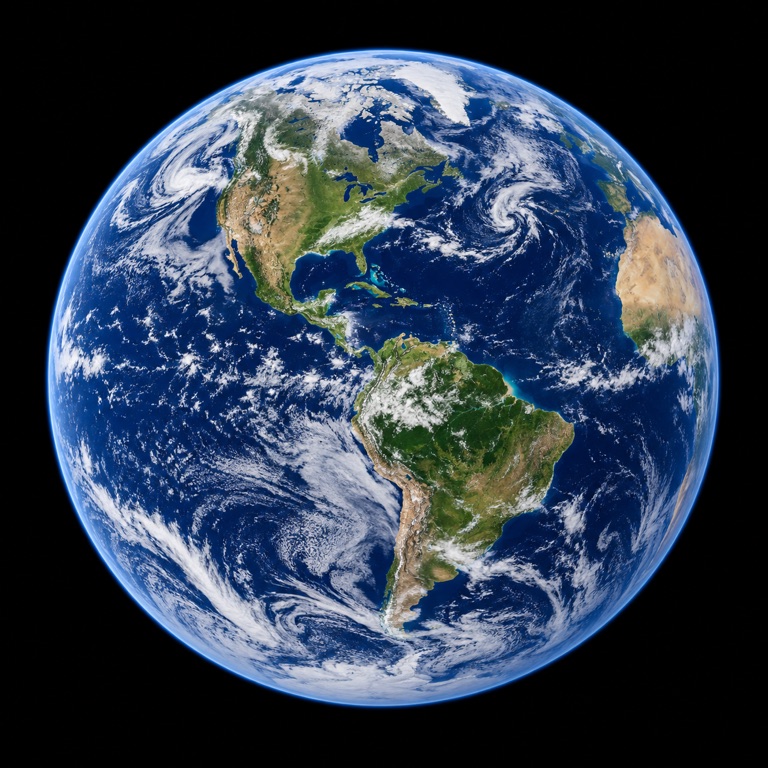
Work it out, one step at a time
Two radii make a diameter
6,371 × 2 = 12,742 km
The line must pass through the centre.
Wrap around the model Earth
12,742 × π ≈ 40,030 km
π is about 3.14. This mean-sphere result differs from the equatorial circumference because the reference shape differs.
Words made simple
- Spherical model
- A simplified Earth treated as a perfectly round ball.
Think about it: On a 10 cm globe, is the radius 10 cm?
The radius is 5 cm. The diameter is twice the radius; the circumference is about 31.4 cm.
Where the numbers come from: NASA JPL. The illustration and worked model are made for this lesson; assumptions are stated above.
Build a scale modelChoose two references and change the model size.
Build a scale model of any two lengths
Choose from all 71 Macro and 54 Micro references, or enter your own length. Set B’s model length and see A change on the same fixed metre ruler. The bars represent the stated lengths, including their different measurement definitions.
- Length ratio A / B
- Model length B
- Calculated model length A
A · Earth circumference
4.008e+7 m
Approximate equatorial circumference, 40,075 km.
Source claim checked
Equatorial, not a meridian circumference; the mean-radius sphere has a different circumference.
Definition and evidence reviewOriginal sourceB · Geostationary orbit
3.579e+7 m
Approximate geostationary altitude above Earth’s equator, 35,786 km.
Source claim checked
Altitude above the surface, not orbital radius from Earth’s centre.
Definition and evidence reviewOriginal sourcemodel A = (A / B) × model B
This calculator uses the existing journey comparison inputs. Review-pending or conceptual entries remain illustrative inputs here; the public reviewed dataset keeps their numeric values withheld. Radius, height, diameter and experimental bound keep their individual definitions.
Why a loop is longer than a diameter
For a circle, circumference equals π times diameter. Earth's 40,075 km value follows the equator; it should be paired with the equatorial diameter rather than the rounded mean diameter when checking that formula.
The meridian follows a different shape
Because Earth is flattened at the poles, a loop through the poles is shorter than the equatorial loop. Both measure a geometric curve; road networks follow their own routes. A round-the-world itinerary adds detours and crossings, so a travel plan uses its own route distance alongside this geometric comparison.
Closest ScaleTrip references
Page distance: 40,075 km
- Earth circumferenceReference measurement: Circumference · 40,075 km
Ratio (page distance ÷ reference): ≈ 1×One complete journey around Earth's equator.
- Geostationary orbitReference measurement: Altitude · 35,786 km
Ratio (page distance ÷ reference): ≈ 1.12×The altitude where a satellite matches Earth's rotation.
- Earth diameterReference measurement: Diameter · 12,742 km
Ratio (page distance ÷ reference): ≈ 3.15×The distance through Earth's centre from one side to the other.
Sources for these values
- NOAA GEONETCast — WGS 84 equatorial calculation — WGS 84 equatorial circumference of approximately 40,075 km · source verified 2026-10-08
- NASA NSSDC — Earth Fact Sheet — equatorial radius 6,378.137 km, polar radius 6,356.752 km; diameter and orbital-radius comparisons derived from these · calculation verified from source value 2026-10-08