A light-year is a distance, just as a walking hour describes a route
At a chosen walking speed of 5 km/h, an hour takes you 5 km. A light-year uses the same idea: speed multiplied by time. It uses light in a vacuum and a defined 365.25-day year.
Work it out, one step at a time
Change one year into seconds
365.25 × 24 × 60 × 60 = 31,557,600 s
Days become hours, then minutes, then seconds.
Multiply speed by time
299,792.458 km/s × 31,557,600 s ≈ 9.46 × 10¹² km
That is about 9.46 trillion kilometres. The seconds cancel, leaving a length.
Words made simple
- 10¹²
- 1 followed by 12 zeros: 1,000,000,000,000.
- Signal delay
- The time a signal needs to cross a distance.
Think about it: A star is 4 light-years away. How old is the light arriving now?
About 4 years ago, in this simple fixed-distance example. Four light-years does not mean a spacecraft arrives in four years.
Where the numbers come from: NIST · NASA JPL. The illustration and worked model are made for this lesson; assumptions are stated above.
Go further: definitions, formulas and a second example
The word “year” makes a light-year sound like a duration. The unit instead records the length light covers in vacuum during a specified year. The distinction matters whenever a distance visualizer also shows travel times.
Derive the length rather than memorise zeros
For this calculation use a Julian year of 365.25 days, with 86,400 seconds per day. That convention gives 31,557,600 seconds. Multiply by the exact vacuum light speed, 299,792,458 m/s: the result is 9,460,730,472,580,800 m. In kilometres that is about 9.46 trillion.
The precision of that unit construction does not make a measured stellar distance exact. A source may give an approximate number of light-years with an uncertainty or a distance-method assumption. Keep the exact unit factor separate from the evidence used to estimate the object’s distance.
Light time answers a signal question
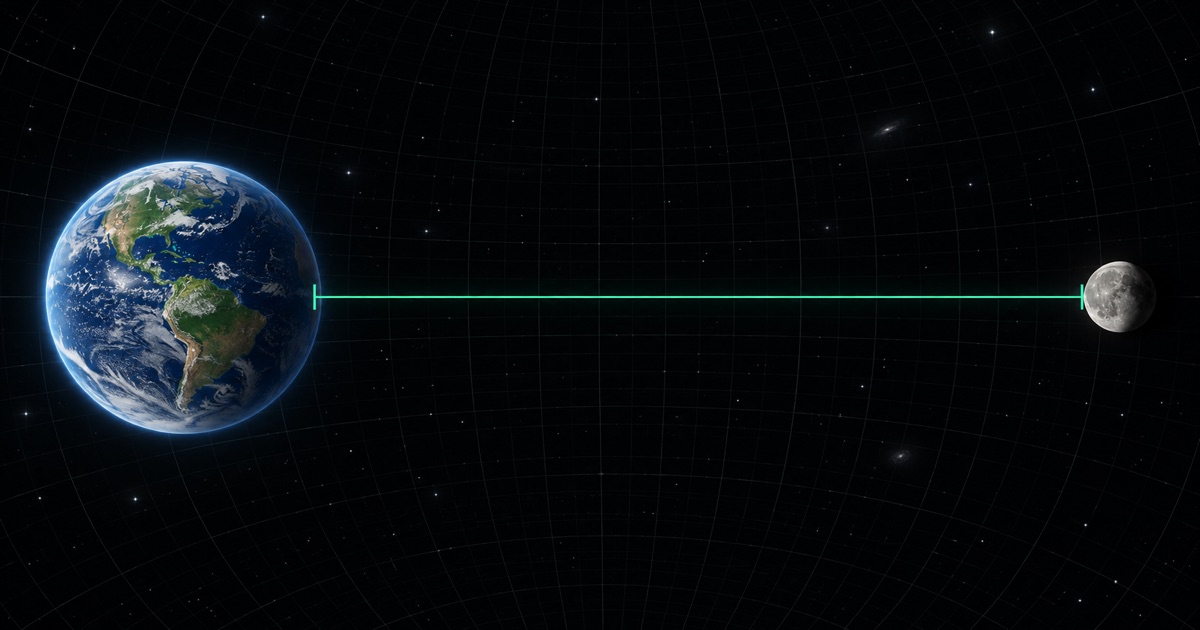
For a fixed separation in a simple vacuum model, one-way light time is distance divided by c. At the Moon’s mean centre separation of 384,400 km the result is about 1.28 seconds. That is a useful scale comparison, not the exact delay between particular antennas at a particular instant.
A command followed by an immediate reply needs outward and return propagation. Doubling the same ideal separation gives roughly twice the one-way time, before equipment or processing delays. Calling that a round trip prevents the common error of reporting a return-time measurement as a one-way distance without dividing by two.
A spacecraft time is another calculation
Dividing a distance by a chosen spacecraft speed is a constant-speed thought experiment. Real missions accelerate, change trajectories and aim for moving destinations. A large number of years in the calculator therefore describes the chosen assumptions; it is not a mission plan or a forecast for future propulsion.
Looking into space also means receiving light emitted earlier. Yet a quoted cosmological distance can use a different definition from light-travel time because the Universe expands. A local distance-over-c example is a good introduction; a cosmological answer must state its model and the kind of distance being reported.
Use the unit to ask a better question
Before comparing two travel-time readouts, write “one way or round trip?”, “vacuum or another medium?” and “fixed separation or moving target?” beside them. These small qualifiers often explain why two apparently conflicting answers can both be sensible.
The useful conclusion is not merely that a light-year is very long. It is that a distance unit, a signal delay and a journey duration are related by explicit assumptions. ScaleTrip keeps the underlying length while changing the displayed unit, so you can examine those relations without losing the reference value.
Reproduce one result
Calculate this result using the definitions and assumptions in the article.
- Expression
- 299,792,458 × 365.25 × 86,400
- Calculated result
- 9,460,730,472,580,800 m
Check the numbers and their sources
Open a source to see what it supports. The picture is our explanation; the original evidence is linked below. These AI-assisted explanations have automated calculation checks, but no expert peer review.
NIST — Definitions of SI base units
Round-trip ranging also requires station/reflector geometry and timing corrections. Source record checked:
Read the original sourceNASA JPL — Astrodynamic parameters
The worked light-year uses the listed Julian-year convention of 365.25 days. Source record checked:
Read the original sourceNASA Space Place — Moon distance
Not the distance on a particular date. Source record checked:
Read the original source