Earth becomes a tiny dot in a 1 m Earth–Sun model
A Solar System picture often enlarges the planets so you can see them. To understand the empty space, keep the same reduction for both the planets and their gaps.
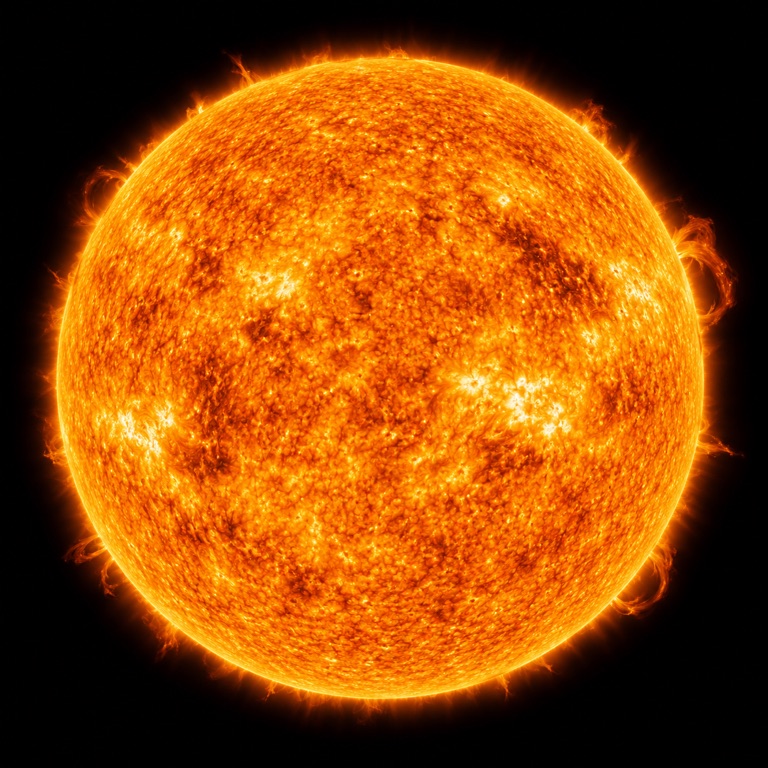
Work it out, one step at a time
Compare Earth’s diameter with the gap
12,742 ÷ 149,597,870.7 ≈ 0.0000852
The diameter and distance must use the same unit: kilometres.
Shrink the gap to 1,000 mm
0.0000852 × 1,000 mm ≈ 0.085 mm
A readable planet icon and a common-scale planet serve different purposes. Check the caption.
Words made simple
- Astronomical unit (au)
- An exactly defined length close to the average Earth–Sun separation.
Think about it: If the model gap is 10 m, does model Earth stay 0.085 mm wide?
No. Every model length grows tenfold, so Earth becomes about 0.85 mm wide.
Where the numbers come from: NASA JPL · NIST SP 330. The illustration and worked model are made for this lesson; assumptions are stated above.
Go further: definitions, formulas and a second example
A diagram can show all the planets clearly, or preserve both their diameters and their enormous separations on a small screen. It usually cannot do all three. Understanding that compromise is the first step toward feeling the scale of the Solar System.
Two lengths hiding in one illustration
A planet diameter is measured across the body. An orbital separation is measured between specified points, usually centres. If Earth is shown as a large disc beside a nearby Sun, both labels can be correct even though the drawing uses different scales for bodies and gaps. Read the legend before treating pixels as a ruler.
This is why the ScaleTrip journey compresses positions and keeps recognisable artwork on screen. Its labelled values and separate scale-model experiment answer the quantitative question. The journey answers a different one: which familiar or astronomical reference comes next as the order of magnitude changes?
Choose one model scale and keep it
Take a deliberately simple classroom rule: one astronomical unit becomes one metre. The astronomical unit is exactly 149,597,870,700 metres. Earth’s rounded mean diameter of 12,742 km then becomes about 0.0852 mm. A visible model Earth is a tiny dot, not a marble. The exact conversion and rounded diameter have different precision.
NASA describes Neptune’s average solar separation as about 30 au. Under that same classroom rule its orbit is roughly thirty metres from the model Sun. This comparison combines a sourced rounded distance with an authored scale choice; it does not assert that Neptune is always thirty metres from a moving model Earth.
An orbit is not the edge of the Solar System
A row of planets is a reading aid, not a map of their positions at one instant. Their orbits occupy different directions and the planets move. Specifying a common radial distance from the Sun makes a useful comparison, but a spacecraft route also depends on launch date, transfer orbit and required arrival speed.
Neptune’s orbit is also only one possible outer reference. Discussions of the Solar System may concern planets, the solar wind’s interaction with interstellar material, or gravitationally associated distant objects. State the boundary being discussed instead of presenting one diameter as the answer to every version of “How big is the Solar System?”
Try a model before replaying the journey
Choose a corridor length, set the model Sun at one end, and calculate the same scale for both planet diameters and orbital distances. If the dots disappear, enlarge the drawing only after marking that second scale. The need for two scales is a discovery about the system, rather than a failure of the model.
Finish by explaining which parts of your model are measurements, which are unit definitions and which are display choices. A successful scale model leaves those roles clear. Then use the Earth–Sun comparison below to change the model size without changing the underlying distance.
Reproduce one result
Calculate this result using the definitions and assumptions in the article.
- Expression
- 12,742,000 / 149,597,870,700 × 1,000
- Calculated result
- 0.085175 mm
Check the numbers and their sources
Open a source to see what it supports. The picture is our explanation; the original evidence is linked below. These AI-assisted explanations have automated calculation checks, but no expert peer review.
NIST SP 330 — Non-SI units accepted for use with SI
The au is exact; an instantaneous orbital separation varies. Source record checked:
Read the original sourceNASA Science — Neptune facts
Rounded mean heliocentric distance, not an Earth–Neptune distance on a date. Source record checked:
Read the original sourceNASA JPL — Planetary Physical Parameters
Equivalent-volume spheres; topography and flattening omitted. Previous NSSDC URL redirects to a status page. Source record checked:
Read the original source