Radius, diameter and circumference are three different routes
Imagine cutting a round orange. A radius runs from its centre to its skin. A diameter goes all the way through the centre. A circumference wraps around the outside.
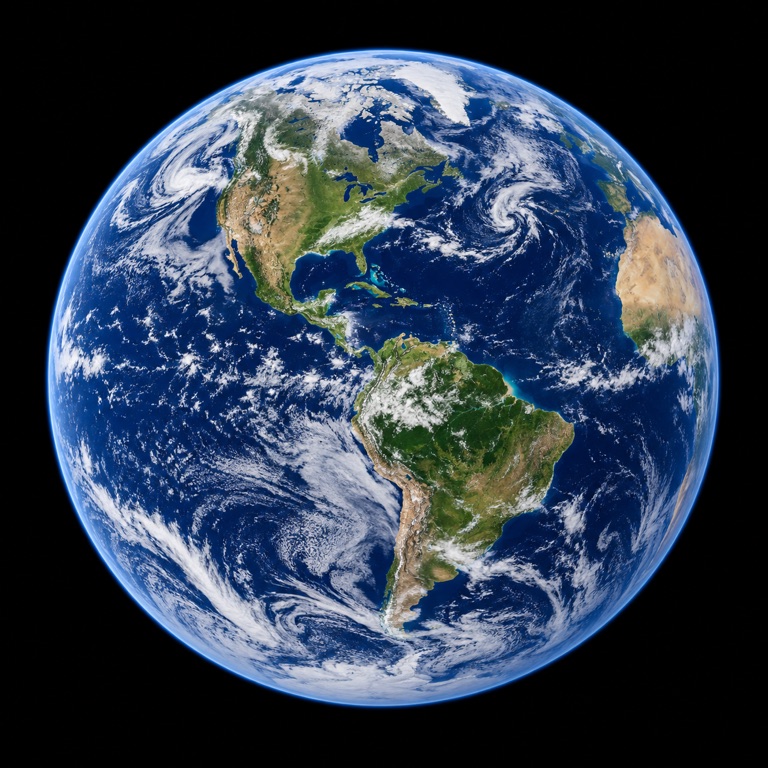
Work it out, one step at a time
Two radii make a diameter
6,371 × 2 = 12,742 km
The line must pass through the centre.
Wrap around the model Earth
12,742 × π ≈ 40,030 km
π is about 3.14. This mean-sphere result differs from the equatorial circumference because the reference shape differs.
Words made simple
- Spherical model
- A simplified Earth treated as a perfectly round ball.
Think about it: On a 10 cm globe, is the radius 10 cm?
The radius is 5 cm. The diameter is twice the radius; the circumference is about 31.4 cm.
Where the numbers come from: NASA JPL. The illustration and worked model are made for this lesson; assumptions are stated above.
Build a scale modelChoose two references and change the model size.
Build a scale model of any two lengths
Choose from all 71 Macro and 54 Micro references, or enter your own length. Set B’s model length and see A change on the same fixed metre ruler. The bars represent the stated lengths, including their different measurement definitions.
- Length ratio A / B
- Model length B
- Calculated model length A
A · Earth diameter
1.274e+7 m
Twice the rounded volumetric mean radius: 2 × 6,371 km.
Calculated from a sourced value
A spherical mean diameter, rather than equatorial or polar diameter.
Definition and evidence reviewOriginal sourceB · Earth radius
6,371 km
Volumetric mean radius, rounded from JPL’s 6,371.0084 km to the existing 6,371 km comparison.
Source claim checked
Equivalent-volume sphere; flattening, terrain and local radius differ.
Definition and evidence reviewOriginal sourcemodel A = (A / B) × model B
This calculator uses the existing journey comparison inputs. Review-pending or conceptual entries remain illustrative inputs here; the public reviewed dataset keeps their numeric values withheld. Radius, height, diameter and experimental bound keep their individual definitions.
Across Earth's interior
Diameter joins opposite surface points through the centre. A surface trip between those points must follow a curved route instead; its distance follows the curved surface rather than the 12,742 km interior diameter.
Mean and equatorial diameter
NASA's equatorial radius of 6,378.137 km implies an equatorial diameter of 12,756.274 km. ScaleTrip uses twice the rounded mean radius instead. These numbers answer different measurement questions, so their small difference reflects those distinct measurement definitions.
Closest ScaleTrip references
Page distance: 12,742 km
- Earth diameterReference measurement: Diameter · 12,742 km
Ratio (page distance ÷ reference): ≈ 1×The distance through Earth's centre from one side to the other.
- Seoul–LondonReference measurement: Distance · 8,850 km
Ratio (page distance ÷ reference): ≈ 1.44×A long-distance route following Earth's curved surface.
- Earth radiusReference measurement: Radius · 6,371 km
Ratio (page distance ÷ reference): ≈ 2×Earth's mean radius from its centre to the surface.
Sources for these values
- NASA Science — Earth and Moon by the numbers — 12,742 km rounded mean diameter derived from twice the listed 6,371 km radius · calculation verified from source value 2026-10-08
- NASA NSSDC — Earth Fact Sheet — equatorial radius 6,378.137 km, polar radius 6,356.752 km; diameter and orbital-radius comparisons derived from these · calculation verified from source value 2026-10-08