Earth becomes a tiny dot in a 1 m Earth–Sun model
A Solar System picture often enlarges the planets so you can see them. To understand the empty space, keep the same reduction for both the planets and their gaps.
Work it out, one step at a time
Compare Earth’s diameter with the gap
12,742 ÷ 149,597,870.7 ≈ 0.0000852
The diameter and distance must use the same unit: kilometres.
Shrink the gap to 1,000 mm
0.0000852 × 1,000 mm ≈ 0.085 mm
A readable planet icon and a common-scale planet serve different purposes. Check the caption.
Words made simple
- Astronomical unit (au)
- An exactly defined length close to the average Earth–Sun separation.
Think about it: If the model gap is 10 m, does model Earth stay 0.085 mm wide?
No. Every model length grows tenfold, so Earth becomes about 0.85 mm wide.
Where the numbers come from: NASA JPL · NIST SP 330. The illustration and worked model are made for this lesson; assumptions are stated above.
Build a scale modelChoose two references and change the model size.
Build a scale model of any two lengths
Choose from all 71 Macro and 54 Micro references, or enter your own length. Set B’s model length and see A change on the same fixed metre ruler. The bars represent the stated lengths, including their different measurement definitions.
- Length ratio A / B
- Model length B
- Calculated model length A
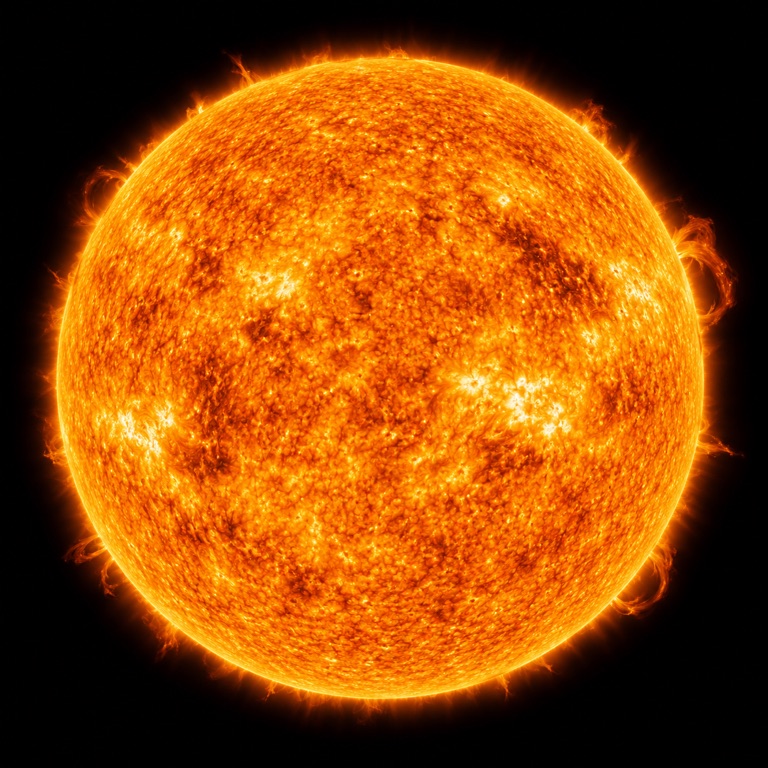
A · Sun diameter
1.392e+9 m
Comparison derived from the nominal solar radius: 2 × 696,000 km = 1,392,000 km.
Calculated from a sourced value
The IAU nominal radius is an exact conversion constant, not the true instantaneous solar radius. This comparison rounds it first; the diameter doubles that rounded radius.
Definition and evidence reviewOriginal sourceB · Sun radius
6.960e+8 m
Comparison derived from the nominal solar radius: 695,700 km → 696,000 km.
Calculated from a sourced value
The IAU nominal radius is an exact conversion constant, not the true instantaneous solar radius. This comparison rounds it first; the diameter doubles that rounded radius.
Definition and evidence reviewOriginal sourcemodel A = (A / B) × model B
This calculator uses the existing journey comparison inputs. Review-pending or conceptual entries remain illustrative inputs here; the public reviewed dataset keeps their numeric values withheld. Radius, height, diameter and experimental bound keep their individual definitions.
How many Earth diameters span the Sun?
Using the displayed 1,392,000 km solar diameter and the 12,742 km mean Earth diameter gives about 109.2. This is a one-dimensional width ratio; a packing comparison would require a separate volume calculation.
A rounded value for a diffuse body
NASA lists a volumetric mean solar radius of 695,700 km. Twice that is 1,391,400 km; ScaleTrip retains a coarser rounded comparison value. The Sun is plasma, so its visible surface is a radiating plasma layer. Displayed travel times are mathematical comparisons across its diameter.
Closest ScaleTrip references
Page distance: 1,392,000 km
- Sun diameterReference measurement: Diameter · 1,392,000 km
Ratio (page distance ÷ reference): ≈ 1×The distance across the Sun through its centre.
- Sun radiusReference measurement: Radius · 696,000 km
Ratio (page distance ÷ reference): ≈ 2×The average distance from the Sun's centre to its visible surface.
- Earth–Moon distanceReference measurement: Distance · 384,400 km
Ratio (page distance ÷ reference): ≈ 3.62×The average centre-to-centre distance from Earth to the Moon.
Sources for these values
- NASA NSSDC — Sun Fact Sheet — rounded solar diameter from the 695,700 km volumetric mean radius · calculation verified from source value 2026-10-08