Radius, diameter and circumference are three different routes
Imagine cutting a round orange. A radius runs from its centre to its skin. A diameter goes all the way through the centre. A circumference wraps around the outside.
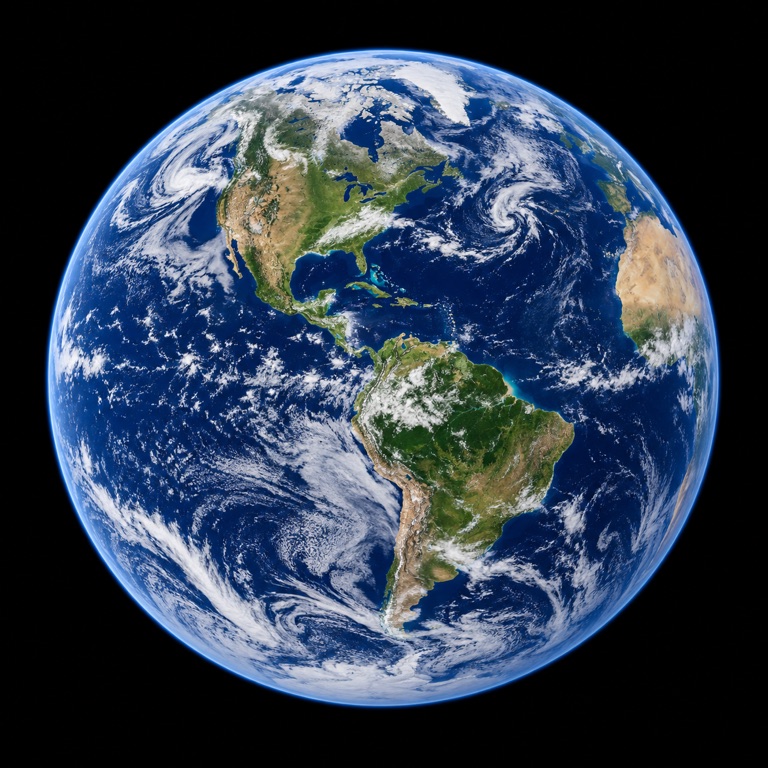
Work it out, one step at a time
Two radii make a diameter
6,371 × 2 = 12,742 km
The line must pass through the centre.
Wrap around the model Earth
12,742 × π ≈ 40,030 km
π is about 3.14. This mean-sphere result differs from the equatorial circumference because the reference shape differs.
Words made simple
- Spherical model
- A simplified Earth treated as a perfectly round ball.
Think about it: On a 10 cm globe, is the radius 10 cm?
The radius is 5 cm. The diameter is twice the radius; the circumference is about 31.4 cm.
Where the numbers come from: NASA JPL. The illustration and worked model are made for this lesson; assumptions are stated above.
Go further: definitions, formulas and a second example
A statement that Earth is “about 6,371 km big” leaves out the most important word: radius. Crossing the globe and travelling around it are different lengths. A few geometry steps turn this ambiguity into a set of useful comparisons.
Start with an explicit spherical model
ScaleTrip uses a rounded mean Earth radius of 6,371 km for several educational calculations. In that sphere the diameter is twice the radius, or 12,742 km. NASA JPL provides a more precise volumetric mean radius; choosing the rounded value is a transparent simplification, not a new measurement of Earth.
Multiply the same radius by 2π and the model circumference is about 40,030 km. A familiar equatorial circumference of about 40,075 km refers to another definition. The difference is expected: a mean-radius sphere and the real equatorial shape are not identical reference surfaces.
An arc and a chord connect the same endpoints differently
On a circle, an arc follows the surface while a chord cuts straight between endpoints. With angle θ in radians, arc length is Rθ and chord length is 2R sin(θ/2). For short separations their difference is small; across a large fraction of the globe it becomes an important part of the question.
Neither curve automatically gives a road route. Roads follow terrain and infrastructure, and a straight underground chord is normally a geometric comparison rather than an available route. State whether the calculator concerns a surface arc, an endpoint separation or a practical journey before attaching a travel time.
A one-metre globe changes the units, not the ratios
If the model diameter is 1 m, a 500 km reference length becomes 500 / 12,742 metres, or about 3.92 cm. The denominator is a diameter because that is the model dimension you chose. Using the radius instead would silently double the displayed length.
This calculation is useful for comparing a regional distance with the planet. It does not place a particular city on the model or describe a tunnel. Latitude, longitude and path geometry would be needed for that. A scale factor preserves a stated length ratio; it does not supply missing geographical context.
Read the noun as carefully as the number
Look for “mean”, “equatorial”, “radius”, “diameter” and “surface” when comparing sources. More digits do not resolve a definition mismatch. Often the best explanation of different answers is that each source measured a different, legitimate dimension of the same planet.
Use the linked radius, diameter and circumference pages as three views of one object. Predict a value before opening each page, then check the measurement label. The exercise builds a habit that also helps with lunar distances, orbital altitudes and microscopic radii.
Reproduce one result
Calculate this result using the definitions and assumptions in the article.
- Expression
- 2 × π × 6,371
- Calculated result
- 40,030.174 km
Check the numbers and their sources
Open a source to see what it supports. The picture is our explanation; the original evidence is linked below. These AI-assisted explanations have automated calculation checks, but no expert peer review.
NASA JPL — Planetary Physical Parameters
Equivalent-volume spheres; topography and flattening omitted. Previous NSSDC URL redirects to a status page. Source record checked:
Read the original sourceNIST — Metric (SI) prefixes
A unit definition is not a measured object size. Source record checked:
Read the original source