Radius, diameter and circumference are three different routes
Imagine cutting a round orange. A radius runs from its centre to its skin. A diameter goes all the way through the centre. A circumference wraps around the outside.
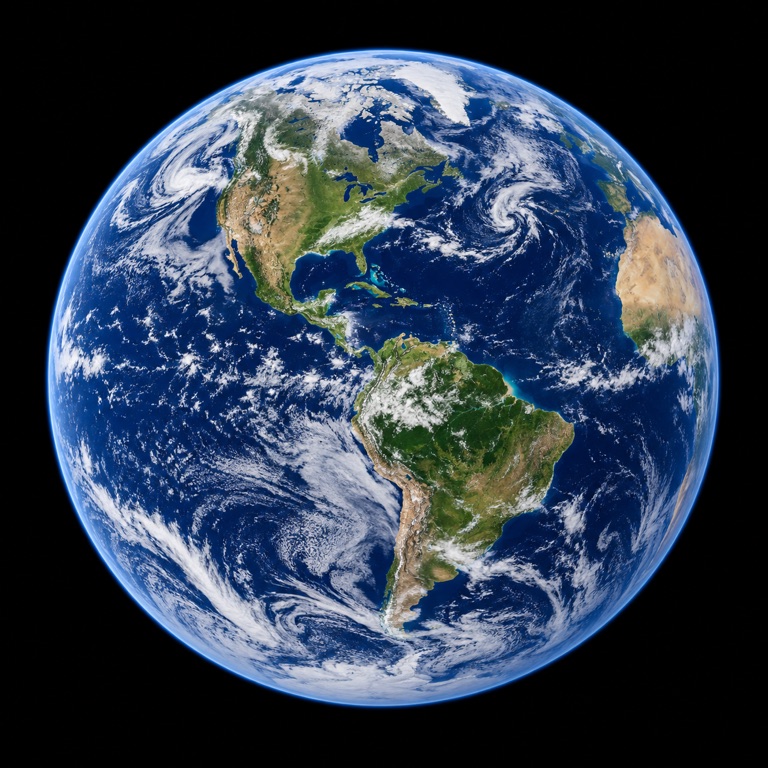
Work it out, one step at a time
Two radii make a diameter
6,371 × 2 = 12,742 km
The line must pass through the centre.
Wrap around the model Earth
12,742 × π ≈ 40,030 km
π is about 3.14. This mean-sphere result differs from the equatorial circumference because the reference shape differs.
Words made simple
- Spherical model
- A simplified Earth treated as a perfectly round ball.
Think about it: On a 10 cm globe, is the radius 10 cm?
The radius is 5 cm. The diameter is twice the radius; the circumference is about 31.4 cm.
Where the numbers come from: NASA JPL. The illustration and worked model are made for this lesson; assumptions are stated above.
Build a scale modelChoose two references and change the model size.
Build a scale model of any two lengths
Choose from all 71 Macro and 54 Micro references, or enter your own length. Set B’s model length and see A change on the same fixed metre ruler. The bars represent the stated lengths, including their different measurement definitions.
- Length ratio A / B
- Model length B
- Calculated model length A
A · Earth radius
6,371 km
Volumetric mean radius, rounded from JPL’s 6,371.0084 km to the existing 6,371 km comparison.
Source claim checked
Equivalent-volume sphere; flattening, terrain and local radius differ.
Definition and evidence reviewOriginal sourceB · Earth diameter
1.274e+7 m
Twice the rounded volumetric mean radius: 2 × 6,371 km.
Calculated from a sourced value
A spherical mean diameter, rather than equatorial or polar diameter.
Definition and evidence reviewOriginal sourcemodel A = (A / B) × model B
This calculator uses the existing journey comparison inputs. Review-pending or conceptual entries remain illustrative inputs here; the public reviewed dataset keeps their numeric values withheld. Radius, height, diameter and experimental bound keep their individual definitions.
One centre, several radius definitions
Earth is slightly flattened at the poles. NASA lists an equatorial radius of 6,378.137 km and a polar radius of 6,356.752 km. The rounded 6,371 km mean is useful for comparisons, while the local radius varies with latitude.
A centre-to-surface depth measure
The radius describes a centre-to-surface segment. Doubling the mean gives the 12,742 km mean diameter. The car and train times above are mathematical comparisons: the centre-to-surface segment is explored virtually through scientific models.
Closest ScaleTrip references
Page distance: 6,371 km
- Earth radiusReference measurement: Radius · 6,371 km
Ratio (page distance ÷ reference): ≈ 1×Earth's mean radius from its centre to the surface.
- Seoul–LondonReference measurement: Distance · 8,850 km
Ratio (page distance ÷ reference): ≈ 0.72×A long-distance route following Earth's curved surface.
- Earth diameterReference measurement: Diameter · 12,742 km
Ratio (page distance ÷ reference): ≈ 0.5×The distance through Earth's centre from one side to the other.
Sources for these values
- NASA Science — Earth and Moon by the numbers — Earth radius of 6,371 km · source verified 2026-10-08
- NASA NSSDC — Earth Fact Sheet — equatorial radius 6,378.137 km, polar radius 6,356.752 km; diameter and orbital-radius comparisons derived from these · calculation verified from source value 2026-10-08