One nanometer is one billionth of a meter. Compare 1 nm with DNA, molecules, cell membranes and atoms on a logarithmic scale.
Each step from millimetre to micrometre to nanometre divides by 1,000
Look at a 1 mm gap on a ruler. Split that gap into 1,000 equal parts: each part is 1 µm. Split one of those parts into 1,000 again: each is 1 nm.
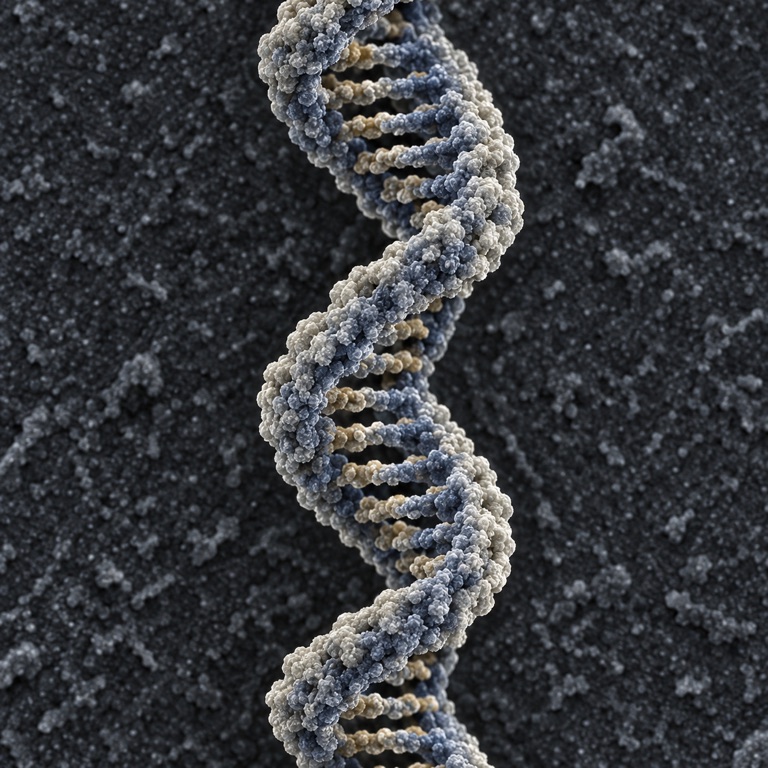
An illustration for recognizing the subject. Read the adjacent diagram for the stated scale.These panels show successive magnifications, not three equal physical lengths. Moving right uses a unit 1,000 times smaller. The same length therefore needs 1,000 times more units.
Work it out, one step at a time
Choose the smaller unit
1 µm = 1,000 nm
Just as 1 m = 100 cm, using a smaller unit gives a larger number.
Apply the rule to a specimen
7.5 µm = 7,500 nm
Do not divide 7.5 directly by a width written as 2 nm. Match the units first.
Words made simple
µm
Micrometre: one millionth of a metre.
nm
Nanometre: one billionth of a metre.
Think about it: Which is longer: 2 µm or 500 nm?
2 µm is 2,000 nm, which is four times 500 nm. A larger written number alone does not mean a longer object.
Where the numbers come from: NIST · NHGRI. The illustration and worked model are made for this lesson; assumptions are stated above.
Build a scale model of any two lengths
Choose from all 71 Macro and 54 Micro references, or enter your own length. Set B’s model length and see A change on the same fixed metre ruler. The bars represent the stated lengths, including their different measurement definitions.
Length ratio A / B
Model length B
Calculated model length A
Fixed scale: 1 m uses 250 drawing units. Moving the model-size slider changes the bar lengths, while the real measurements stay fixed. Full ratio view: the longer length fills the width. Sub-pixel lengths retain their computed width; read the numerical ratio for very different scales.
A · One nanometre
1 nm
A defined length marker in metres, not an observation of an object.
Exact defined scale marker
Exact unit relation only; artwork conveys context.
This calculator uses the existing journey comparison inputs. Review-pending or conceptual entries remain illustrative inputs here; the public reviewed dataset keeps their numeric values withheld. Radius, height, diameter and experimental bound keep their individual definitions.
One nanometer (1 nm) equals 10⁻⁹ meters, one thousandth of a micrometer. It sits near the scale of small molecules and is about half the diameter of the DNA double helix.
Representative value1 nm
In meters1 × 10⁻⁹ m
Measurement typeCharacteristic length
Put it in context
What are we measuring at this scale?
DNA is about 2 nm in diameter, while characteristic atomic dimensions are a few tenths of a nanometer. These are different measurement types: DNA uses a molecular diameter, while an atom has a diffuse quantum boundary.
Compare the related scales
These ratios divide the displayed representative lengths. Unit markers, diameters, characteristic lengths and charge radii describe different measurements; read each ratio as a length comparison using those measurement definitions.