Each step from millimetre to micrometre to nanometre divides by 1,000
Look at a 1 mm gap on a ruler. Split that gap into 1,000 equal parts: each part is 1 µm. Split one of those parts into 1,000 again: each is 1 nm.
Work it out, one step at a time
Choose the smaller unit
1 µm = 1,000 nm
Just as 1 m = 100 cm, using a smaller unit gives a larger number.
Apply the rule to a specimen
7.5 µm = 7,500 nm
Do not divide 7.5 directly by a width written as 2 nm. Match the units first.
Words made simple
- µm
- Micrometre: one millionth of a metre.
- nm
- Nanometre: one billionth of a metre.
Think about it: Which is longer: 2 µm or 500 nm?
2 µm is 2,000 nm, which is four times 500 nm. A larger written number alone does not mean a longer object.
Where the numbers come from: NIST · NHGRI. The illustration and worked model are made for this lesson; assumptions are stated above.
Go further: definitions, formulas and a second example
Micro and nano are not interchangeable words for “very small”. They encode a factor of one thousand in length. Learning to carry that factor through a calculation is more useful than memorising a list of objects that happen to fit one scale.
A prefix is a mathematical definition
NIST lists micro as 10⁻⁶ and nano as 10⁻⁹. Consequently 1 µm = 1,000 nm, and 1 nm = 0.001 µm. A unit conversion changes the notation, not the object. The same length can be written either way without becoming more or less microscopic.
This differs from a scientific observation that a particular sample is a certain number of nanometres wide. The unit definition is exact; the sample measurement has conditions, precision and possibly a range. A trustworthy explanation should show both instead of placing an exact-looking unit beside an unexplained representative object.
Divide lengths expressed in the same unit
Choose a 1 µm model line and a 100 nm model line. The first is 1,000 nm, so the ratio is 10. Both are authored teaching lengths, not claimed average bacterium or virus sizes. The calculation isolates unit handling without depending on a biological classification.
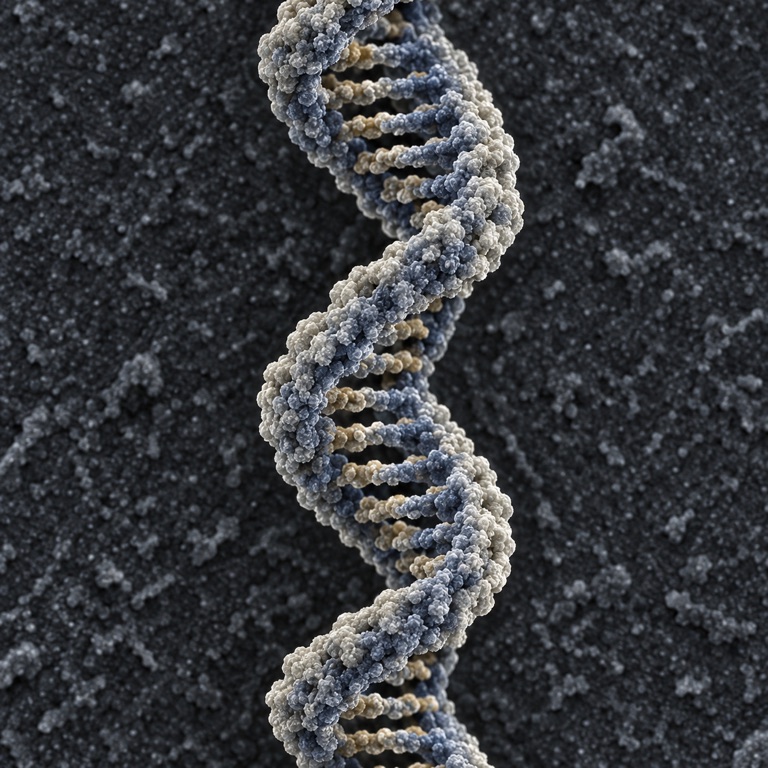
Using DNA’s approximate width of 2 nm gives another check: a 1 µm line spans 500 such widths end to end. That wording concerns a one-dimensional comparison. It does not show the packing, orientation or total contour length of actual DNA molecules in a volume.
Three dimensions amplify a length change
For geometrically similar objects, multiplying all lengths by ten multiplies area by one hundred and volume by one thousand. Multiplying by one thousand in length gives one million in area and one billion in volume. State the similarity assumption before applying these powers to real objects.
A thin sheet, a rod and a sphere with the same named width need not have comparable volumes. This is one reason a cell, a virus illustration and a molecule cannot be counted simply by cubing the displayed ratio. The dimension being compared remains part of the answer.
Use a scale bar as an anchor
A scale bar labels a length within an image. When an image is resized together with its bar, the relationship can stay meaningful. A screenshot cropped away from that bar loses useful context. In ScaleTrip the separate numeric records let you return to the stated measurement even when the artwork is enlarged for clarity.
Practice by writing one value in metres, micrometres and nanometres, then explaining what was measured. Correct powers of ten and a clear measurement noun do more for understanding than a sequence of increasingly dramatic zoom images.
Reproduce one result
Calculate this result using the definitions and assumptions in the article.
- Expression
- 10⁻⁶ / 10⁻⁹
- Calculated result
- 1,000 ×
Check the numbers and their sources
Open a source to see what it supports. The picture is our explanation; the original evidence is linked below. These AI-assisted explanations have automated calculation checks, but no expert peer review.
NIST — Metric (SI) prefixes
A unit definition is not a measured object size. Source record checked:
Read the original sourceNHGRI — DNA Day transcript, question 296
Diameter, not the length of a DNA molecule. Source record checked:
Read the original source