Hidden planets in gravitational waves: the LISA idea
A planet can tug on its stars. New research asks how that motion might mark a gravitational-wave signal.
- NASA release / papers
- Sources checked
Two studies prepare for future discoveries
NASA highlighted two Astrophysical Journal papers on 10 November. One analyses planetary clues in gravitational waves; the other models independent confirmation. LISA is in development: these are forecasts, not a planet discovery.[1] [2] [3]
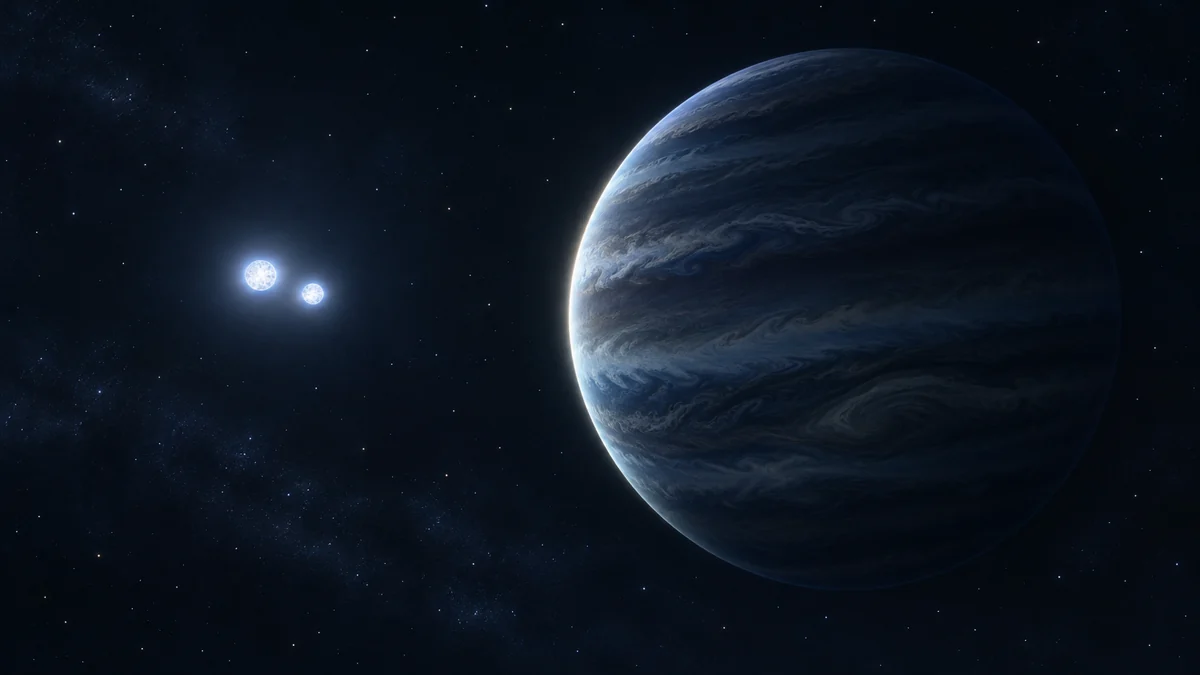
A planet makes the binary wobble
White dwarfs are compact stellar remnants. A close pair emits gravitational waves. An outer planet can tug the pair into reflex motion, changing the observed frequency through the Doppler effect.
An approaching or receding siren offers a familiar analogy. Modulation creates sidebands beside the main frequency, carrying planetary clues. Gravitational waves themselves are not sound travelling through air.[1] [2]
Could Webb check the candidate?
The second study models a representative binary, combining infrared excess with astrometry. Extra infrared light could help reveal a planet. Mass, temperature, distance and observing time limit which candidates could be checked.[3]
A 2.5-million-km arm, in two motions
ESA-led LISA will use three spacecraft linked by lasers. A nominal arm is 2.5 million km, about 6.50 times the mean Earth–Moon distance of 384,400 km.
Try exaggerated binary wobble, then one-way light travel: 2,500,000 ÷ 299,792.458 ≈ 8.34 s. The latter assumes a fixed arm; neither scene is a measured gravitational-wave signal.[4] [5] [6]
The binary also moves around a shared centre
Twelve seconds is the lesson duration. Orbital periods, mass ratios and measured waveforms are not reproduced.
One nominal arm: 2.5 million km
Fixed length and vacuum light speed are assumed. Real separations vary, and GW measurements combine multiple laser links.
Binary wobble can carry a planetary clue. One-way light time is a separate measurement.
What evidence would come next?
Earlier work proposed the method; these papers refine detection and confirmation conditions. Noise, observing time and LISA’s own motion matter. The wobble animation does not determine a planet’s mass, and 8.34 s is a light-travel time within the instrument, not a planet-search duration.[2] [3] [4]
Sources and scope
- NASA · New Worlds
Announcement and forecasts; not a detection.
- McGrath · ApJ 1012, 17
GW radial velocity, modulation and detection limits.
- McGrath et al. · ApJ 1012, 18
Infrared/astrometry confirmation in a model case.
- NASA · LISA mission
Future mission; nominal 2.5-million-km arms.
- NASA · Moon facts
Mean Earth–Moon distance; ratios are teaching calculations.
- NIST · SI length
Exact vacuum light speed for the fixed-arm model.