Why the Moon moves away, and Earth without it
The Moon is a little farther away than when you were born. That small change connects oceans, the length of a day and billions of years. Follow the evidence before asking when our companion might disappear.
- Apollo 11 reflector deployed (UTC)
- Ancient-distance paper published
- Sources checked
How small is 3.8 cm a year?
Mark 3.8 cm on a ruler. At today's average rate, ten years add 38 cm, a century adds 3.8 m, and fifteen years add about 57 cm. These are short constant-rate illustrations. Against a mean centre distance of 384,400 km, one year's increase is roughly one part in ten billion.
The Moon follows an elliptical orbit, so its distance also changes by tens of thousands of kilometres over a month. The small long-term growth sits underneath those large periodic changes. Recession describes a trend in the orbit's average size, rather than a distance that rises every day.[1] [2]
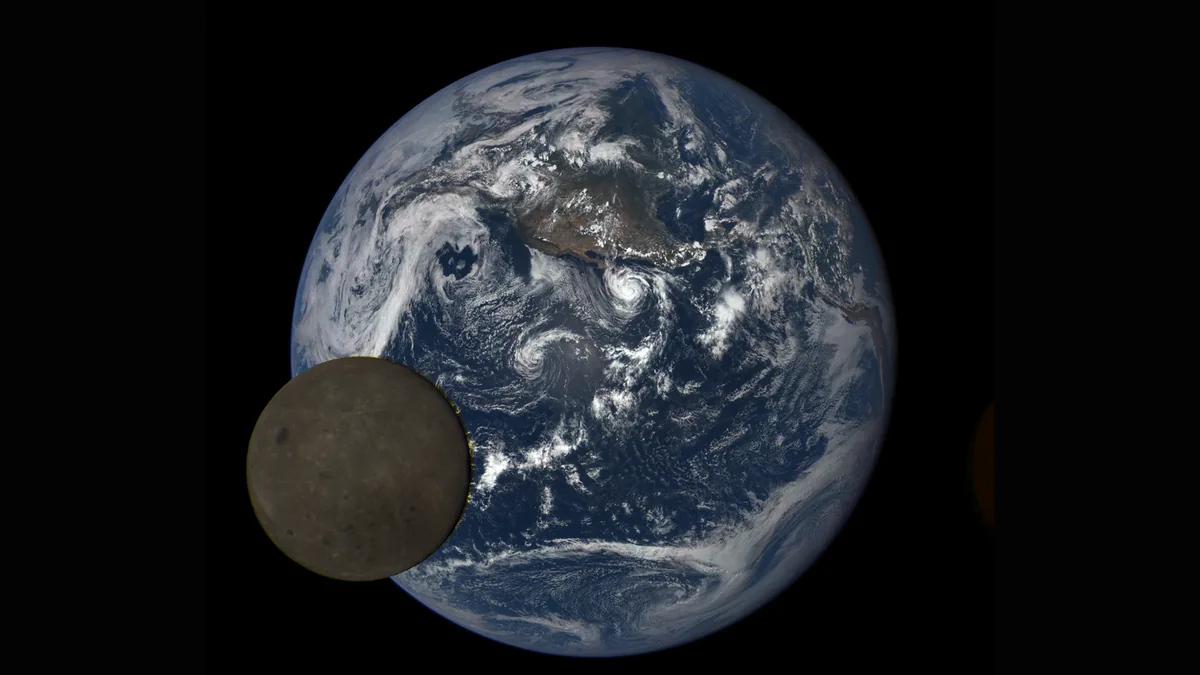
How can we measure such a tiny change?
Apollo 11, 14 and 15 astronauts installed retroreflector arrays. Like a road reflector, each returns light toward its source. An observatory sends a short laser pulse and times the returning photons. At the mean distance, light takes about 1.28 seconds each way.
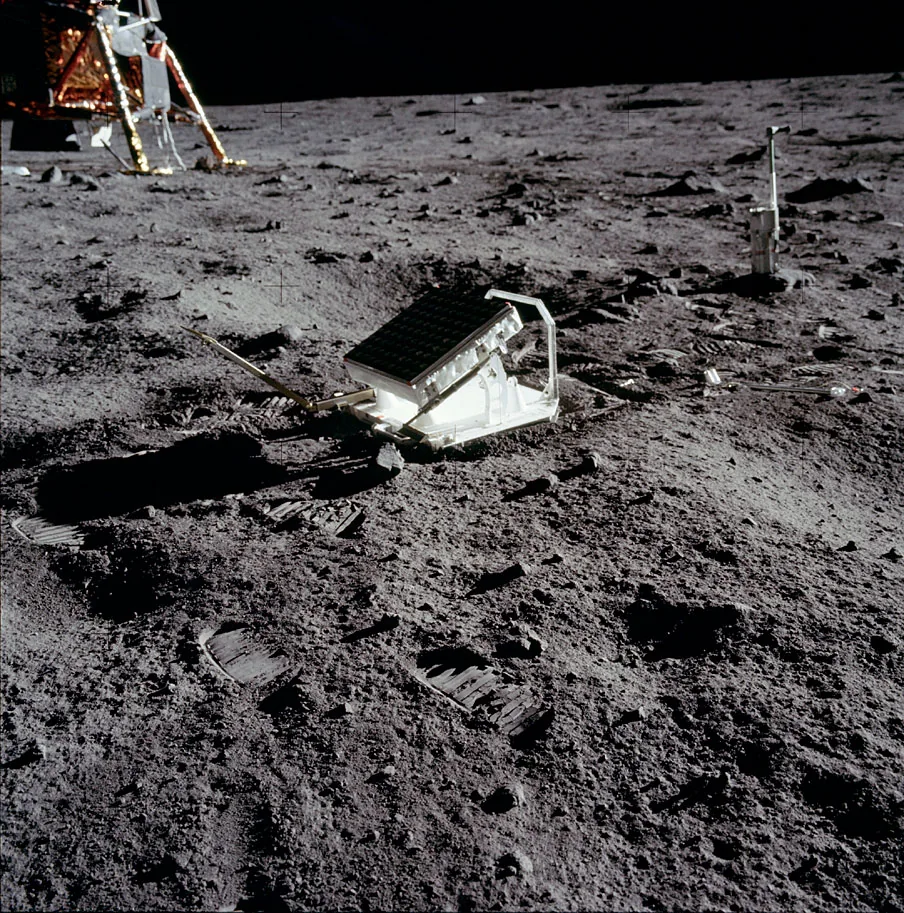
The idea is distance = light speed × round-trip time ÷ 2. Dividing by two converts the return journey into a one-way distance. It resembles timing a mountain echo, using light instead of sound.
Real analysis models the atmosphere, station position, Earth's rotation and the Moon's orientation and orbit. Telescope-to-reflector measurements must be related to centre-to-centre distance. APOLLO combines observations at millimetre-level range precision; many years of data and orbital modelling reveal the secular trend.[3] [4] [1]
1.28 s outbound + 1.28 s return ≈ 2.56 s round trip
Different gravitational pulls stretch Earth
The near side is pulled more strongly than Earth's centre, and the far side less strongly. Relative to the centre, that difference stretches both sides. This is a tide-generating effect. Oceans respond visibly, and the solid Earth deforms too.
Two smooth bulges are a teaching model. Continents, depth and narrow passages complicate real water motion, just as a container changes how water sloshes. Local high tides require local predictions, rather than simply following the Moon overhead.[6] [7]
Earth's faster spin pulls the Moon forward
Earth spins in about a day; the Moon orbits relative to the stars in about 27.3 days. Earth's rotation and dissipative tidal response shift its average deformation ahead of the Earth–Moon direction. That offset mass pulls the Moon along its orbit. The reciprocal torque slows Earth's spin.
Angular momentum is a quantity describing rotational motion. Some passes from Earth's spin to the lunar orbit. Earth loses spin energy; part increases lunar orbital energy and the rest is largely dissipated as heat. The wider orbit has a longer period, even though the torque acts forward during the transfer.[5] [6]
Earth's day grows slowly
Tidal braking lengthens the day by a few milliseconds per century in approximate present-day estimates. A millisecond is one thousandth of a second. The change is tiny for a wristwatch but accumulates over long intervals.
Atmospheric and ocean circulation, ice and Earth's interior also change rotation. Short-term speeding up can coexist with long-term tidal braking. Scientists separate these contributions by comparing observations and physical models.[5] [8]
The recession rate has changed
Moving continents alter ocean shape and depth. Ocean resonance can strengthen tidal dissipation when natural sloshing periods match the forcing, like pushing a swing at the right rhythm. Today's rate cannot simply describe the entire past.
A 2022 study interpreted rhythmic layers in 2.46-billion-year-old sedimentary rocks. Its reconstruction gives a distance of 321,800 ± 6,500 km and a day of 16.9 ± 0.2 hours. This combines geological dating, cycle interpretation and astronomical models, unlike direct modern laser ranging. The uncertainty ranges belong with the results.[8] [9]
When will the Moon disappear?
Science has no fixed disappearance date. The measured 3.8 cm/year is today's orbital change. Tidal strength, orbital period, Earth's rotation and oceans evolve together; indefinite constant-speed extrapolation would miss that feedback.
In a simplified isolated Earth–Moon model, approaching equal spin and orbital periods reduces the offset driving this exchange. The real system also includes solar tides and stellar evolution. NASA describes the Sun's red-giant transformation on a roughly five-billion-year horizon. Heating, changing orbits and possible engulfment depend on long-term models, also affecting the Moon's fate.
Leaving Earth's orbit, becoming too small to cover the Sun, and physically ceasing to exist are different outcomes. Each needs its own conditions. Keep measurements, conditional estimates and unresolved endpoints separate.[8] [5] [11]
Total solar eclipses may end first
Hold a coin farther from your eye: it looks smaller. A more distant Moon also covers a smaller angle. Its ability to cover the whole Sun declines; an annular eclipse leaves a bright solar ring.
A NASA educational estimate extends the present rate to place the final total eclipses on a scale beyond roughly 600 million years, while noting solar growth changes the timing. Treat this as a rough conditional estimate, not a dated forecast. A Moon can remain in orbit after total eclipses end.[10] [2]
A Moonless thought experiment: the oceans
Now suppose the Moon is removed without impact, debris or added energy, while other initial conditions stay the same. This is a thought experiment, separate from recession. Lunar tides disappear; solar tides remain. NOAA puts solar tide-generating force at roughly half the present lunar contribution. Local tidal ranges would not all shrink by one fixed fraction.
Intertidal rhythms, coastal mixing and ecosystems could change, requiring local modelling. For a simple distance comparison, lunar tide-generating strength scales as 1/distance³: doubling distance gives one eighth of the strength. This neither dates a doubled-distance future nor predicts a harbour's water level.[7] [6]
The spin axis responds over long times
The Moon affects Earth's long-term spin-axis behaviour. Changed tilt redistributes seasonal sunlight. Moonless models depend on other planets and the initial spin; both the size and speed of variations matter.
Li and Batygin's 2014 model found changes slow enough to allow long-term habitability. It is a conditional model result, not a single inevitable climate future. Removing the Moon also leaves Earth's existing spin: an instant halt or immediate jump to a different day length would require an additional physical mechanism.[12] [5]
A different sky, a connected Earth
Moonlight, lunar phases and eclipses involving the Moon would vanish. Stars, planets, atmospheric glow and artificial light would remain. Earth's rotation and orbit would still underpin days and years.
Remember three things beneath tonight's Moon: laser records support the present recession; tidal torque links it to Earth's spin; and distant outcomes require changing oceans, rotation and the Sun. Studying a slowly retreating Moon also means studying Earth's time and seas.[2] [3] [8]
Sources and scope
- NASA · Lunar laser ranging
Apollo-era ranging; about 3.8 cm/year
- NASA · Moon facts
Mean distance, rotation, orbit and phases
- UC San Diego · APOLLO
Pulse timing, measurement endpoints and modelling
- NASA / ILRS · Reflectors
Apollo reflector construction and deployment
- NASA GSFC · Secular acceleration
Tidal torque, recession and length of day
- NASA · Tides
Tidal offset, solar tides and local geography
- NOAA · What causes tides?
Tide-generating force scales as inverse distance cubed
- Farhat et al. · A&A / author manuscript
Published tidal-history model; ocean resonance
- Lantink et al. · PNAS
2.46 Ga reconstruction: distance and day-length ranges
- NASA · Eclipse archive FAQ
Conditional eclipse estimate; changing solar size
- NASA · Sun facts
Billion-year stellar evolution; uncertain terrestrial fate
- Li & Batygin · ApJ / author manuscript
Moonless spin-axis models and habitability limits