A calculator cannot make an estimated input exact
Suppose you call a route “about 10 km.” Dividing it can produce many decimal places, but you still do not know the route to the nearest centimetre. Keep the original measurement’s limits in mind.
Work it out, one step at a time
Write what you chose
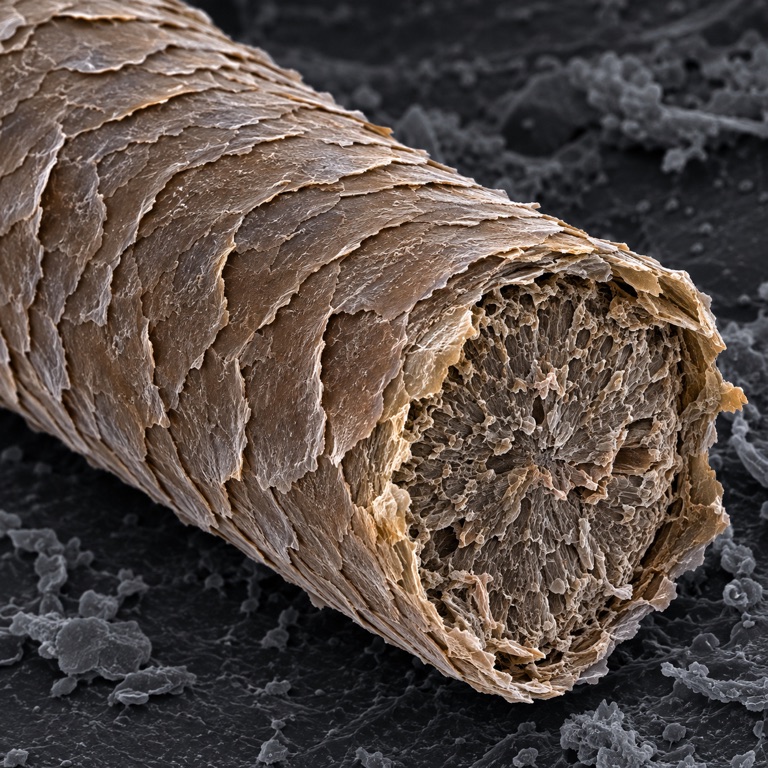
hair: 80 µm; DNA: 2 nm
The hair width is a chosen representative. The DNA width is approximate.
Change an input and watch the result
80,000 ÷ 2 = 40,000; 100,000 ÷ 2 = 50,000
The arithmetic is reproducible, but the answer depends on the input.
Words made simple
- Exact definition
- A unit relation fixed by agreement, such as 1 km = 1,000 m.
- Approximation
- A value close enough for the stated purpose, with limited precision.
Think about it: Is 80.000000 µm automatically more trustworthy than 80 µm?
No. Extra zeros do not replace a measurement method, uncertainty estimate or source.
Where the numbers come from: van den Berg et al. · NHGRI. The illustration and worked model are made for this lesson; assumptions are stated above.
Go further: definitions, formulas and a second example
A calculator can print many digits even when its input is only an approximate reference. The display may be arithmetically consistent and still imply more certainty than the evidence supports. Understanding the status of each input is part of reading the result.
Four kinds of numerical statements
An SI prefix is a definition. A measured hair width depends on a sample and method. An 80 µm model hair is a chosen representative. A particle-search bound is a result under a tested model. All can be useful, but they support different claims and should not receive one undifferentiated “verified size” label.
A range also needs a name. Natural variation among specimens is different from uncertainty in estimating a mean. A confidence interval, standard uncertainty and illustrative display band are not interchangeable. A reader needs to know what procedure generated the endpoints before using them as evidence.
Change an input and follow the result
For a ratio q = A/B, increasing A by ten percent increases q by ten percent if B stays fixed. Increasing B instead reduces q by the factor 1/1.1, about nine percent. This direct recalculation is a simple sensitivity test that works before introducing a statistical model.
If A is an illustrative band from 50 to 100 µm and B is a chosen 2 nm width, the endpoint ratios are 25,000 and 50,000. Reporting those endpoints is honest when they are called an illustration. Calling them a 95% confidence interval would require a sampling and statistical justification that this calculation does not supply.
Rounding is part of the explanation
Use enough digits to reproduce the arithmetic, then interpret the result at the precision of the inputs. A mean astronomical distance or a representative biological width rarely justifies treating every displayed decimal as measured information. A full calculation can remain available without putting every digit in the headline.
An exact conversion factor does not remove uncertainty in the source. Converting a measured kilometre distance into metres multiplies the value and its uncertainty together. The number of decimal places changes with the unit, while the underlying quality of the observation stays the same.
Read a result as a short argument
A reusable numerical explanation says what was measured, how it was measured, what was assumed and how the result was calculated. Sources should support the specific claim next to them. A prestigious organisation’s link is not evidence for every unrelated number on the page.
The public data page distinguishes sourced numeric entries from records still awaiting verification. Keeping an unresolved value out of a downloadable factual dataset is a useful editorial decision, not a missing feature to conceal. New evidence can improve the resource without rewriting an old assumption as an observation.
Reproduce one result
Calculate this result using the definitions and assumptions in the article.
- Expression
- 1 / 1.1
- Calculated result
- 0.909091 ×
Check the numbers and their sources
Open a source to see what it supports. The picture is our explanation; the original evidence is linked below. These AI-assisted explanations have automated calculation checks, but no expert peer review.
NIST — Metric (SI) prefixes
A unit definition is not a measured object size. Source record checked:
Read the original sourcevan den Berg et al. — Human hair cross-sections, Tables 4–5
Small donor sample; 80 µm is ScaleTrip’s chosen representative. The 50–100 µm display band is illustrative, with specimens outside it. Source record checked:
Read the original sourceNIST — 2022 CODATA (PDF page 47)
Charge distribution radius, rather than a hard boundary or diameter. Source record checked:
Read the original sourceNIST — Definitions of SI base units
Round-trip ranging also requires station/reflector geometry and timing corrections. Source record checked:
Read the original source