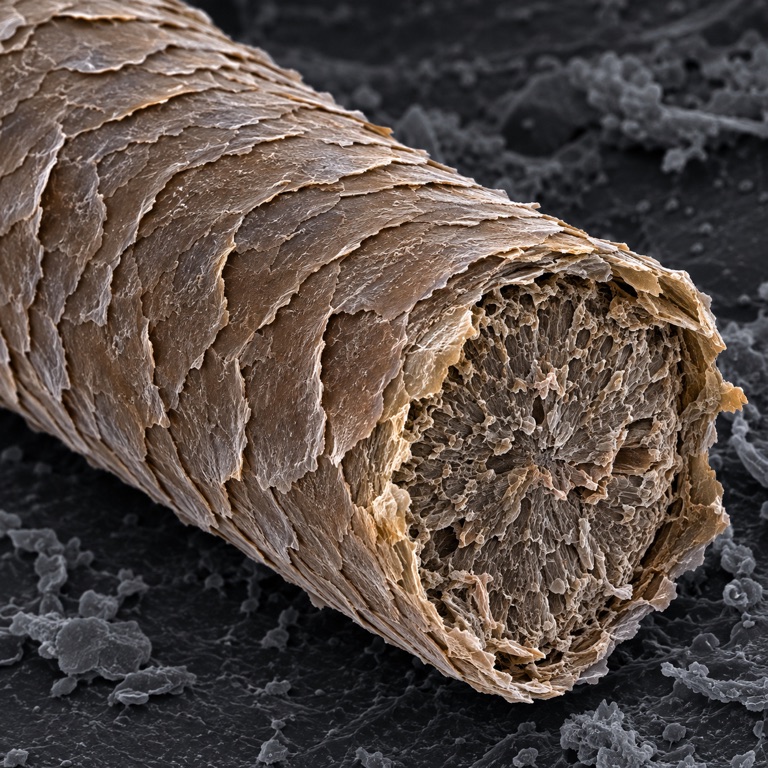
A hair can look narrow from one direction and wide from another
Think of looking at an oval pencil from different sides. A hair’s cross-section can be oval too. One width is not always enough to describe the strand.
Work it out, one step at a time
Change micrometres to nanometres
80 × 1,000 = 80,000 nm
This chosen width makes the arithmetic easy; real strands vary.
Compare with a 2 nm DNA width
80,000 ÷ 2 = 40,000
The chosen hair width is 40,000 times the chosen DNA width.
Words made simple
- Representative value
- A selected useful example; it is not true for every specimen.
Think about it: If the chosen hair width is 100 µm, does the DNA ratio stay 40,000?
It becomes 100,000 ÷ 2 = 50,000. A different input gives a different result.
Where the numbers come from: van den Berg et al. · NHGRI. The illustration and worked model are made for this lesson; assumptions are stated above.
Go further: definitions, formulas and a second example
A hair feels like a tiny cylinder, but a cross-section can be oval and irregular. Rotating the same strand can change the measured width. That makes hair an unusually good introduction to what a scientific “size” actually means.
Name the axis before quoting a diameter
An ellipse has a major axis and a minor axis. A measurement across one is not interchangeable with a measurement across the other. The hair cross-section study linked below compares micro-CT and laser-micrometry measurements and reports axis-dependent quantities, rather than one universal human-hair thickness.
A study mean also belongs to a study sample. The source’s donor groups do not automatically represent every age, ancestry, hair treatment or point along a strand. A source can be reliable while the question “What is everyone’s hair diameter?” still needs a much broader measurement design.
Use an explicitly chosen reference
The ScaleTrip comparison chooses 80 µm and an illustrative 50–100 µm display band. Those choices make a useful familiar reference; they are not certified population bounds. A strand outside the band is compatible with the purpose of the model because the band was never a biological limit.
Using a 2 nm DNA width, convert 80 µm to 80,000 nm and divide by 2: the ratio is 40,000. With the same chosen DNA width, the two ends of the illustrative hair band give 25,000 and 50,000. This interval describes sensitivity to our illustrative inputs, not a confidence interval from a new hair study.
Resolution and magnification answer different questions
Making an image larger makes its existing features easier to inspect. It does not by itself add information about a smaller structure. To report a width, an image also needs a calibrated scale, an edge definition and a documented measurement method. An attractive enlarged texture alone supplies none of those conditions.
Preparation can matter too: a strand’s orientation, cross-section cut and imaging procedure determine which boundary is being examined. Comparing methods means asking whether they estimate the same quantity, not simply selecting whichever machine prints more decimal places.
Keep variation in the story
Write a caption for a model hair that includes its chosen width, the axis assumption and a statement about variation. Then change only the width in the scale comparison. The result should change continuously, while the meaning of DNA width stays fixed.
The lesson is useful far beyond hair: sample means, natural ranges and exact units are different kinds of information. Showing those differences is not a weakness in a reference resource. It lets a reader use the comparison for the question it can actually answer.
Reproduce one result
Calculate this result using the definitions and assumptions in the article.
- Expression
- (80 × 10⁻⁶) / (2 × 10⁻⁹)
- Calculated result
- 40,000 ×
Check the numbers and their sources
Open a source to see what it supports. The picture is our explanation; the original evidence is linked below. These AI-assisted explanations have automated calculation checks, but no expert peer review.
van den Berg et al. — Human hair cross-sections, Tables 4–5
Small donor sample; 80 µm is ScaleTrip’s chosen representative. The 50–100 µm display band is illustrative, with specimens outside it. Source record checked:
Read the original sourceNHGRI — DNA Day transcript, question 296
Diameter, not the length of a DNA molecule. Source record checked:
Read the original sourceNIST — Metric (SI) prefixes
A unit definition is not a measured object size. Source record checked:
Read the original source