An atom has no hard painted edge
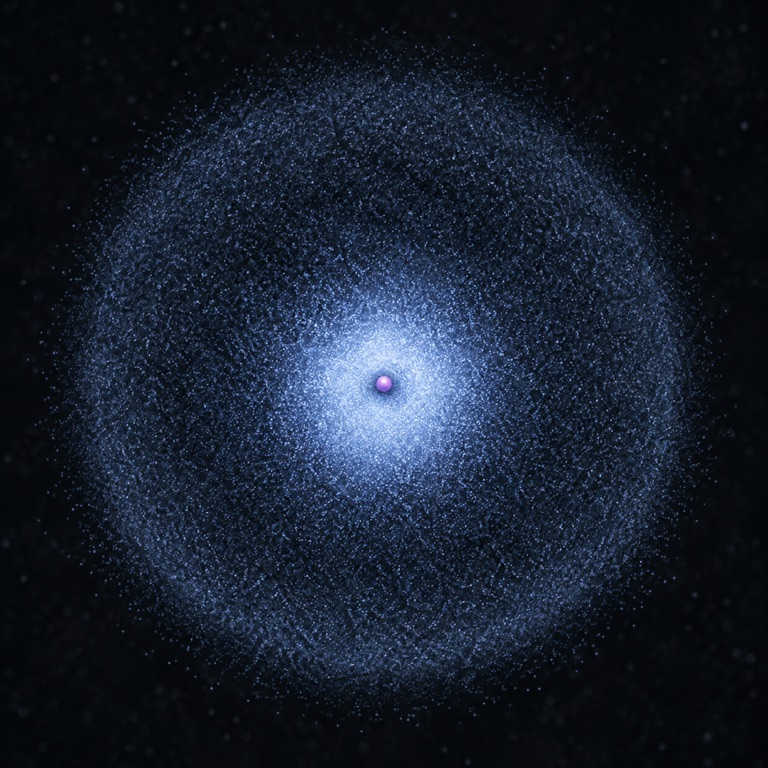
A cloud has a dense centre and a fuzzy edge. An electron-cloud picture also uses a spread-out pattern, but it represents the chance of finding an electron. It is not a photograph of fog or a little planetary orbit.
Work it out, one step at a time
Read a very small length in a convenient unit
0.0529 nm × 1,000 = 52.9 pm
These rounded values describe the Bohr radius, not a hard outer surface.
Ask what was measured
1 pm = 0.001 nm
Atoms can have different radius definitions. A different definition can give a different number.
Words made simple
- Characteristic length
- A length that helps describe how a physical system behaves.
Think about it: Does the coloured cloud boundary act like a glass wall?
No. It is a display choice for a probability distribution. Read the measurement definition before comparing radii.
Where the numbers come from: NIST · NIST. The illustration and worked model are made for this lesson; assumptions are stated above.
Go further: definitions, formulas and a second example
A glowing sphere is a memorable atom illustration, but it suggests a sharp surface that the measurement does not supply. Atomic size becomes clearer when we ask which property of the electron distribution a quoted length describes.
A characteristic length gives a useful reference
The Bohr radius is about 5.29177 × 10⁻¹¹ m, or 52.9 pm. It is an atomic characteristic length, not a ruler measurement of a solid hydrogen ball. NIST publishes its value and uncertainty as part of the CODATA constants, making both the definition and precision traceable.
Multiplying that radius by two defines a convenient characteristic span. It does not identify a boundary beyond which the electron can never be found. When a resource quotes an atomic radius, look for whether it concerns an isolated atom, bonding, an electron-distribution convention or another operational definition.
An electron cloud is a visual encoding
In an electron-cloud illustration, brightness, opacity or dots may represent the relative distribution of electron probability. Those are choices for communicating a quantum description. The cloud is not atmospheric fog, and an illustrated orbit is not a camera record of a tiny planet circling a nucleus.
A photograph-like material can help readers remain oriented during a zoom, but realism of texture is not evidence of direct observation. ScaleTrip labels these scenes conceptual and keeps the source and measurement type next to the value, so the scientific claim comes from the documented quantity rather than the rendering style.
Compare with a nucleus while keeping the definitions
A proton’s RMS charge radius is about 0.84075 fm. Dividing the Bohr radius by that value gives roughly 62,900. This compares an atomic characteristic length with a charge-distribution radius, not two hard surfaces. The large ratio is informative only when both measurement nouns remain visible.
A sentence such as “the atom is mostly empty” can be a starting analogy for the separation of nuclear and atomic scales, but it does not explain all of matter’s behaviour. Chemical interactions involve electron distributions, quantum states and electromagnetic effects. Empty-looking illustration space should not be mistaken for a complete physical model.
Ask what the boundary means
Compare two atom diagrams and find the legend that explains their surface or cloud. If one uses a probability contour and another a bonding radius, similar outlines need not describe identical measurements. This is a productive difference to explain rather than a reason to choose the more realistic picture.
The linked atom and proton pages preserve their own definitions. Use the comparison controls to explore the length ratio, then state explicitly that the ratio relates two different ways of characterising spatial extent. That is a more precise conclusion than assigning every atom a single immutable diameter.
Reproduce one result
Calculate this result using the definitions and assumptions in the article.
- Expression
- (5.29177210544 × 10⁻¹¹) / (8.4075 × 10⁻¹⁶)
- Calculated result
- 62,941.09 ×
Check the numbers and their sources
Open a source to see what it supports. The picture is our explanation; the original evidence is linked below. These AI-assisted explanations have automated calculation checks, but no expert peer review.
NIST — 2022 CODATA, Bohr radius (PDF page 45)
An atomic characteristic length, not a hard atomic edge. Source record checked:
Read the original sourceNIST — 2022 CODATA (PDF page 47)
Charge distribution radius, rather than a hard boundary or diameter. Source record checked:
Read the original source