A charge radius describes how charge is spread out
A proton is not a tiny billiard ball with a sharply measured skin. Experiments study how its electric charge is distributed. The charge radius summarizes that distribution with one length.
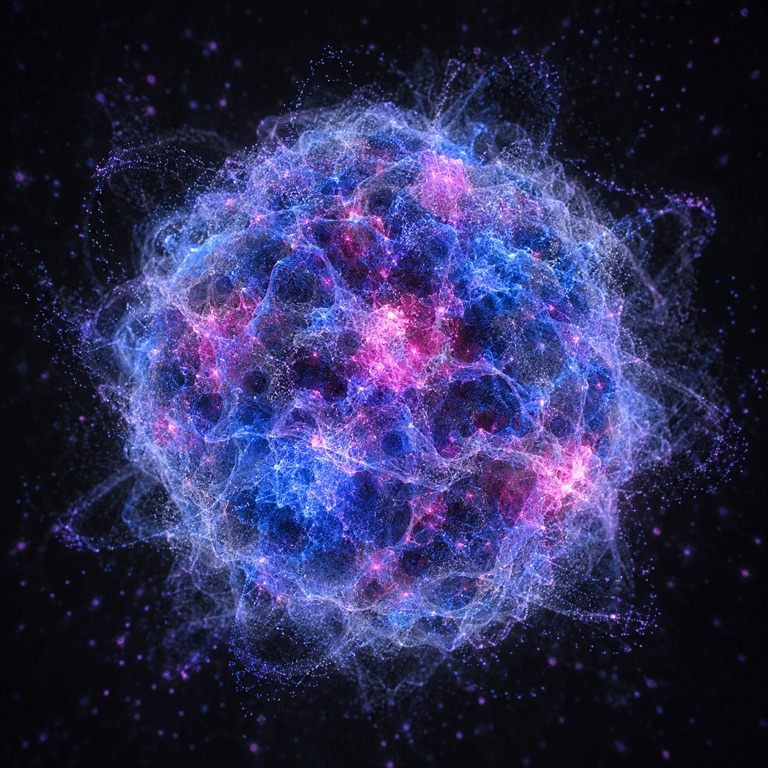
Work it out, one step at a time
Use femtometres to avoid a long decimal
8.4075 × 10⁻¹⁶ m = 0.84075 fm
One femtometre is one quadrillionth of a metre, or 10⁻¹⁵ m.
Read the uncertainty beside the value
0.00064 ÷ 0.84075 × 100 ≈ 0.076%
This is the listed standard uncertainty divided by the central value, not the variability of a hard surface.
Words made simple
- RMS charge radius
- A root-mean-square distance used to summarize the charge distribution.
Think about it: Can you double this number and call it a measured hard diameter?
No. Doubling a charge-radius number does not create a measured hard boundary. Keep the words “charge radius” attached to it.
Where the numbers come from: NIST. The illustration and worked model are made for this lesson; assumptions are stated above.
Go further: definitions, formulas and a second example
The proton is often drawn as a compact coloured ball. Its published charge radius is a more specific quantity: a length characterising the spatial distribution of electric charge. Reading it correctly keeps a striking scale image tied to what experiments actually estimate.
What the letters RMS add
RMS means root mean square. A radius of this type summarises a distribution by weighting squared distance and taking a square root, rather than locating the outermost particle. Its scientific use depends on the charge-distribution definition and the measurement analysis behind it.
NIST’s 2022 CODATA value is 8.4075(64) × 10⁻¹⁶ m. Expressed in femtometres it is 0.84075 fm. Parentheses record standard uncertainty in the final digits; they do not describe a range of visible surface roughness or a possible change of proton size during the animation.
Convert the uncertainty with the value
The stated standard uncertainty is 6.4 × 10⁻¹⁹ m, or 0.00064 fm. Dividing by 0.84075 fm gives a relative standard uncertainty of about 0.076%. This is a calculation from the cited constant, not a new experimental evaluation or a confidence guarantee about all measurement methods.
A rounded display of 0.84 fm is appropriate for an introductory scale comparison, but carrying every decimal into a large artwork would not add visual accuracy. Keep the full source value available for calculations and use readable rounding for the explanation. Precision and legibility serve different roles.
How a distribution becomes a number
Scattering and spectroscopic measurements constrain proton structure through physical models and carefully analysed observations. They are not photographs with a ruler placed beside the proton. A useful educational image should identify this inference step rather than present an apparent surface as the measured result.
Multiplying the charge radius by two produces twice that characteristic length. It still does not establish a hard proton diameter. Likewise, comparing it with the Bohr radius is a comparison of defined lengths, not a proof that the nucleus and atomic cloud are miniature versions of one another.
Report the quantity, not just the exponent
Write the result as “proton RMS charge radius ≈ 0.84075 fm” and link its source. If you build a model, label its chosen display radius separately. This preserves the difference between a sourced constant, a calculated ratio and an illustrator’s shape.
The small exponent is only part of what makes the measurement interesting. The more important lesson is that experiments can infer spatial structure even where everyday ideas of a visible edge stop being useful. The source and definition let another reader evaluate that claim.
Reproduce one result
Calculate this result using the definitions and assumptions in the article.
- Expression
- 0.00064 / 0.84075 × 100
- Calculated result
- 0.076123 %
Check the numbers and their sources
Open a source to see what it supports. The picture is our explanation; the original evidence is linked below. These AI-assisted explanations have automated calculation checks, but no expert peer review.
NIST — 2022 CODATA (PDF page 47)
Charge distribution radius, rather than a hard boundary or diameter. Source record checked:
Read the original sourceNIST — 2022 CODATA, Bohr radius (PDF page 45)
An atomic characteristic length, not a hard atomic edge. Source record checked:
Read the original source