Not seeing a structure is different from measuring its size
A blurry photo that cannot reveal a small mark does not tell you that the mark is exactly one pixel wide. Particle searches also report what their data can rule out under a tested model.
Work it out, one step at a time
Compare the two stated lengths
(8.4075 × 10⁻¹⁶) ÷ 10⁻²⁰ = 84,075
The comparison uses a proton charge radius and a model-dependent search scale.
Keep the interpretation attached
10⁻²⁰ m ≠ measured quark diameter
A search bound can change with the experiment and model. It is not proof of a smallest possible length.
Words made simple
- Experimental bound
- A constraint supported by data under specified assumptions.
Think about it: Does “no structure found” mean “nothing smaller exists”?
No. The result is limited to what was tested and how the data were interpreted.
Where the numbers come from: CMS · NIST. The illustration and worked model are made for this lesson; assumptions are stated above.
Go further: definitions, formulas and a second example
At the end of a micro-scale journey, the smallest label can look like the size of the smallest object. A collider search asks a different question: would the data reveal a proposed internal structure at a given scale?
Start with the observation and the tested model
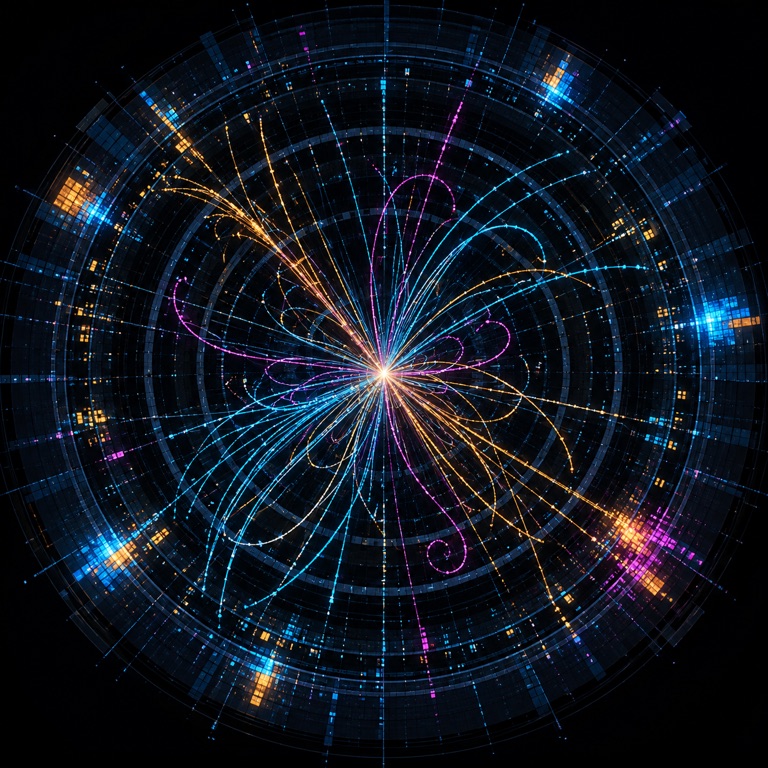
CMS describes using dijet angular measurements to investigate possible quark substructure, reaching an order-of-magnitude length scale of 10⁻²⁰ m in the discussed models. Detectors record the products of collisions. Their distributions are compared with predictions; the explanation does not depend on resolving a quark as a coloured sphere.
An exclusion result says which proposed parameters are incompatible with the observations at the stated analysis level. Changing the interaction model can change how an energy-related limit is expressed as a length. The model name, assumptions and confidence language therefore belong with any serious numerical summary.
You can compare lengths without equating their meanings
As an arithmetic illustration, dividing the proton charge-radius value 8.4075 × 10⁻¹⁶ m by 10⁻²⁰ m gives 84,075. The first is a charge-distribution radius; the second is an order-of-magnitude search scale. The ratio is a mathematical comparison, not a count of quarks across a proton.
Because the search label is only an order of magnitude, a presentation such as “about eighty thousand times smaller in stated length scale” is more faithful than implying five-digit physical precision. Keeping the exact arithmetic available and rounding the interpretation is a useful editorial choice.
Conceptual artwork should not become evidence
A particle illustration can show an event pattern, a detector context or a symbolic interaction. It cannot supply a directly observed surface that the analysis did not measure. ScaleTrip identifies these scenes as conceptual and treats the experimental frontier as a search context rather than a discovered object diameter.
The Planck length belongs to another discussion: a theoretical combination of constants, not the next experimentally imaged object below a collider limit. A separate theoretical epilogue makes that change of evidential status visible instead of letting a smooth zoom conceal it.
Read the claim at the precision the source supports
When reading a headline about probing deeper into matter, look for what was measured, what model was tested and whether the result is a detection or a limit. Those questions transfer to many fields where instruments infer something smaller than a directly visible feature.
The educational reward is not a promise that the smallest label reveals the final layer of nature. It is understanding how scientific knowledge can advance through carefully stated non-detections, stronger constraints and better comparisons between data and models.
Reproduce one result
Calculate this result using the definitions and assumptions in the article.
- Expression
- (8.4075 × 10⁻¹⁶) / 10⁻²⁰
- Calculated result
- 84,075 ×
Check the numbers and their sources
Open a source to see what it supports. The picture is our explanation; the original evidence is linked below. These AI-assisted explanations have automated calculation checks, but no expert peer review.
CMS — What is inside quarks? CMS looks deeper (7 April 2026)
Model-dependent exclusion length; no measured quark diameter. Source record checked:
Read the original sourceNIST — 2022 CODATA (PDF page 47)
Charge distribution radius, rather than a hard boundary or diameter. Source record checked:
Read the original source